2024 14% 0,75 lt

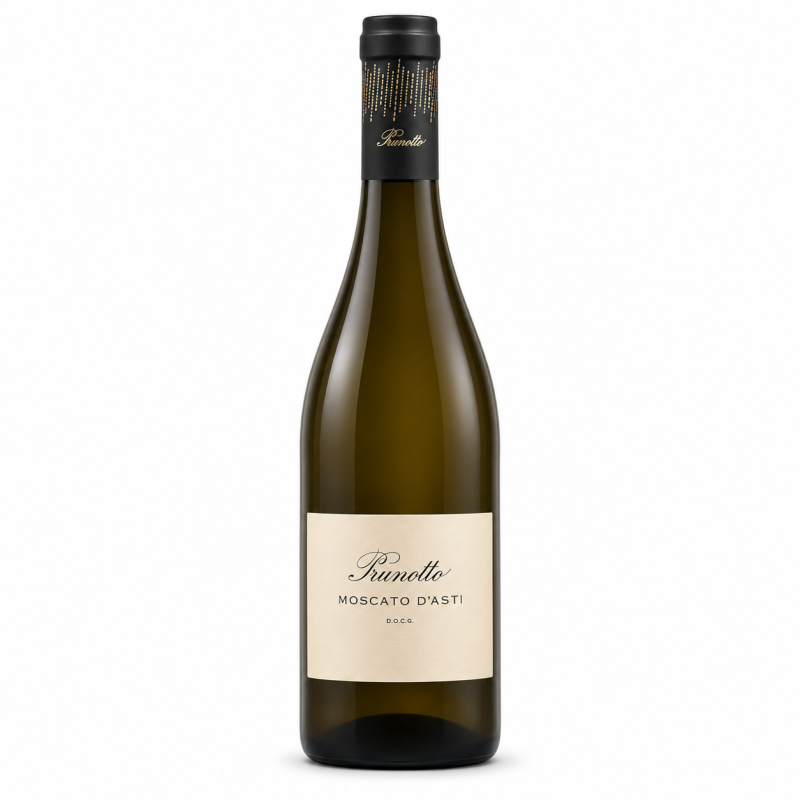
Some sweet wines are valued as much for their fragrance as for their richness on the palate. Prunotto’s 2026 Moscato d’Asti DOCG belongs to a Piedmontese tradition in which the character of the grape itself is fundamental. The distinctive idea behind this label is to balance natural sweetness with freshness rather than pursue extreme concentration. Moscato Bianco di Canelli provides the raw material for a wine that retains a close connection to the aromas of freshly harvested grapes. It offers a different way to finish a meal from a concentrated passito, with the grape’s fragrance and the appellation’s typically modest alcohol level taking centre stage.
The estate’s origins lie in the cooperative winery established at Serralunga d’Alba in 1904. Alfredo Prunotto subsequently became an established name in the Langhe, and the Antinori family began working with the winery in 1989, taking over production in 1994. Alongside its traditional red wines, Moscato illustrates a different aspect of Piedmontese wine culture.
The Moscato d’Asti appellation covers part of southern Piedmont across the provinces of Asti, Cuneo and Alessandria. In these hills, white Muscat is closely associated with the production of aromatic wines. Prunotto’s use of the variety known as Moscato Bianco di Canelli reflects that historical connection without confusing the wine’s appellation with other geographical designations.
Prunotto’s established production method involves harvesting by hand and allowing the grapes to rest briefly in the press before separating the juice. The aim is to make the most of aromatic compounds in the skins, which are especially important in a variety such as Muscat. The free-run juice is handled in stainless steel, with an emphasis on preserving the varietal character of the fruit.
Fermentation is stopped by chilling, leaving some of the grapes’ original sugar in the wine. This principle distinguishes Moscato d’Asti from a dry white: the sweetness does not require drying the grapes and accompanies a modest alcohol content. Clarification and filtration precede bottling. The intended result is a wine whose aromatic origins remain readily apparent.
The winery’s characteristic tasting profile describes a straw-yellow appearance and a bouquet that combines recognisable Muscat aromas with hawthorn and hints of sage. These elements create a particularly interesting relationship between floral and herbal impressions, ensuring that sweetness is not the only aspect of the wine’s personality.
Freshness on the palate is essential to understanding Prunotto’s style: it supports the sweetness and contributes to an agreeable finish. Unlike Asti Spumante, Moscato d’Asti belongs to the non-spumante category, although it can have a gentle spritz. The 2026 release belongs to this tradition, whose youthful expression is particularly worth appreciating.
Traditional Piedmontese pastries are natural partners. Biscuits, cornmeal cookies and hazelnut cake bring textures that contrast with the lightness of the wine. Fruit tarts and sweet leavened cakes also work well, allowing the sweetness of Moscato to accompany that of the dish.
Serve chilled at around 8–10°C to preserve freshness without muting the fragrance too much. This 75 cl bottle suits those who would rather finish a meal with an aromatic wine than a heavily concentrated dessert wine. Fresh fruit offers an alternative to pastries, especially when a simple, fragrant dessert is preferred.
Each characteristic is rated from 0 to 5: 0 means absent, 5 means most pronounced. At a glance you can tell whether the wine suits your taste.